Showing posts with label Teaching. Show all posts

Wednesday, April 24, 2013

Learning to unicycle + awesome videos

Just thought it would be helpful to give a quick review of my time learning to unicycle.  I decided to learn in 2009, and in all, it originally took about 1 or 2 weeks, depending how you count, and I found it most helpful to practice for 20 minutes per day.  Any amount of time longer than that was unproductive, as the muscles and balancing required for this sport were so different than anything I'd done, and so I lost control a bit after that long.  So in summary: short, sweet, don't change things, and repeat.

Also, it's a great skill to learn, to keep your brain in learning mode and agile, and I think that this guy's assessments of the benefits of juggling carry over to unicycling quite well:

  1. brain growth
  2. body comfort
  3. stress relief
  4. focus retention
  5. coordination boosting
  6. being interesting
  7. improved learning
  8. unboring meditation

I'm not completely sold on the meditation, but most of the others hold!  Read more here.


New Hobby for HB

Wherein I display to the world, for accountability, my desire to learn to ride a unicycle, with very little external input.  I practiced for about 20 minutes per day, and let my muscles take their time in learning the new motions.


Unicycle: Days 6 & 7

Day 6 is when I started actually riding without holding onto things - traveling up to 30 feet or so (I had limited space).  Day 7 is when I switched shoes - bad idea.  Keep all variables constant in the beginning!

Unicycle: Days 8 & 9

Practie makes perfect!  Trying to ride on new surfaces - bumpy walkways, around buildings, etc.  First time to circumnavigate the block, with multiple dismounts (falls).


Unicycle: Day 10

Inventing challenges!  I decided to go to the school down the street and use their wide-open spaces.  Rode around the basketball court a few times without falling!


Day 15: Let's go to the park

Practiced riding up and down smooth paths, and continued to realize that riding on grass is difficult with a small wheel!

Unicycle progress tracker

Again, when learning, try to keep the equipment setup as unchanged as possible!


Day 17: Hittin' the (unicycle) gym

Wherein I continued to create new challenges for myself, to practice turning both directions, such as on a slalom course, shown here.  Basically just trying to improve my riding control.


What's next?

Not sure!  I haven't ever learned to ride backwards for any real distance, nor have I learned to "hover" in place, by riding forward & backward quickly.  Another option is to give up the pavement and learn to ride more 'diverse' terrain.  Enjoy!

Three awesome youtube videos about unicycling:

Impressive:


Inspiring:


Hilarious:


My posts, in reverse order, for some reason:
http://www.whereisholden.com/search?q=unicycle&max-results=20&by-date=true


Monday, February 18, 2013

I've taken the plunge into MOOCs

I've taken the plunge into 21st century education - online learning!  A MOOC is a Massive Open Online Course where thousands (tens and hundreds of thousands) of pupils can view course content at their own pace, or choose to synchronize learning and help each other in tutorial sessions or via forums or other online tools.  Here's a Wikipedia article.

An important distinction is that online learning can return us to the one-to-one model that formal education started with (I'm thinking about individual tutors, about 500 years ago).  With online courses, there's plenty of overview material accessible via Wikipedia and other credible websites.  Then, when I need a deeper dive, I can easily, instantly find an expert who will look me in the eye (via a prerecorded video) and explain the subject.  When I don't understand, I can re-watch the video, play it slower, or take alternate videos.  When I enter a course with information I already understand, I can play the video at 1.5 or more speed.

Here's my preliminary list of online education.  Please give me any feedback / pointers / additional resources in the comments!

Khan Academy - Learn almost anything for free 

The first online course that I heard about, probably through at TED talk.  I like Khan's presentation style, and the idea that you can take successive courses that build on each other, from the same professor (ie. Arithmetic all the way through Algebra, Geometry, Calculus, and Differential Equations, and chart your progress through problem sets and final tests.  Amazingly transformative.  Not all agree.


Coursera - Take the World's Best Courses, Online, For Free


I'm currently 4 weeks into my 8 week microeconomics course, and loving it!  This happened to have the subject and timeline that fit my needs.  I'm also signed up for a macroeconomics course.  I accompany the course with a generic economics textbook, borrowed from a friend.  The course has videos, separate video tutorial (different instructor), a wiki for sharing class notes, forums for discussion, weekly goals/objectives, timeline, key phrases/concepts, and guiding questions.  I'm currently spending a bit less than the suggested 8 hours per week, total.


Udacity - Learn.  Think.  Do.


edX - The Future of Online Education


Udemy - Start Learning from the Worlds Top Instructors


This one sounds like an awesome course: Energy Economics and the Environment: Environmental issues require trade-offs, primarily in how we use energy. A former White House economist offers answers.  Free.


iTunes U - Learn Anything, Anywhere, Anytime.


MIT OpenCourseware - Free MIT courses


The Great Courses 


As far as I know, the only non-free resource on here.  Bill Gates is a huge proponent and takes classes all the time apparently.  And he's super smart.  I want to believe that these are much better than the free resources, but haven't had the opportunity to test yet.  Courses range from $50 to $300, much less than in the university setting!

Open Yale


TED - Ideas Worth Spreading


http://www.ted.com/
Not particularly academic, but excellent online stimulation tool for all sorts of subjects!


Reviews

Finally, I think we need more resources like CourseTalk, where online courses, professors, and features can be rated, for their own feedback, and for the benefit of students who want to find the BEST course in a certain subject area.  I think this type of resource will be really helpful in a couple of years once the data is in place, and I can only hope there's some semblance of uniformity between ratings, etc.


Sunday, July 27, 2008

OLPC Laptops in the Classroom - report

This post goes back to April when I was teaching science to the 6th, 7th, and 8th graders
at Chiragh Grammar School, in Meerut, India. I was experimenting with the role of the low cost, rugged, OLPC laptop computers in science classrooms.
So how did it go? Well I just so happened to write it all up! Although I wrote up this full report (20 pages) in early May, we weren't sure where the report should go. If you're interested in reading it all, find it over at Iridescent Inc -- the non-profit science education group I've been involved with the past few years in Los Angeles.

Click here to download the report.
Click here for Iridescent's Educator website.

Since I wasn't sure the audience that I was writing this for, nor where the report would show up, I didn't put a whole lot of effort into polishing it (grammatically or otherwise). That said, I put in our experiences and hope that others can benefit from what we learned!

Monday, May 5, 2008

Renewable Energy (Re)Sources

The Challenge:

In my last-minute lesson-planning preparation for this past Earth Day, April 22nd, I was desperately searching for some good simple graphics to demonstrate the various forms of renewable energy. Having a captive audience (e.g. 6th, 7th, and 8th graders), and a legitimate platform (Electricity Chapter), I figured that the least I could do was to give them a bit of history on renewable energy, and have a discussion on why all this magical "free" power from the sun, Earth's core, wind, and water (unfortunately) plays such a small role in our current energy sourcing.

I figured that the intermittent and irregular power outages here in Meerut would be some inspiration for these budding young scientists to improve the situation. (The newspaper last week pegged our power outages at 18 hours a day, but this is sensationalist reporting. Honestly we rarely go above 8 total hours without power (one outage each morning, afternoon, and night).)

The heart of the issue is population, in my mind, but family size is a religious affair here in India, so I thought it best to leave that alone. At its most basic level, the real reason we have outages is insufficient supply to meet current demand levels. With a State-run power system, free markets haven't been able to provide alternatives. The State is in a tough spot as well, and claims they can't afford to increase infrastructure because people aren't paying their electrical bills. It's not hard to imagine that folks are stealing electricity.

(All this is only my opinion, based on 4 short weeks in a land that has been inhabited for 4500 years. I know I'm a newcomer, so please correct me by leaving an insightful comment!)

But I digress.

The Challenge: (really this time...)
Where are the education materials? I searched for a single set of coherent, simple diagrams to help convey the underlying concepts of how these different methods generate power, and I just couldn't find any. There needs to be a good, complete set which discusses renewable/alternative energy options!

Please post a link if you have one!

Wikipedia page about India's sources of power:
Thermal (coal, gas, oil): 65%
Hydro: 26% (awesome!)
Nuclear: 3% (not renewable, but a safe alternative to oil, in my opinion)
Renewable: 6% (must be wind and solar?)

(Of tangential relevance: "The government of India has set up a "Power for all by 2012" goal" [wikipedia] Does this mean constant power, or intermittent, shut-your-business-down-for-hours-each-day power?)

Major Contenders:

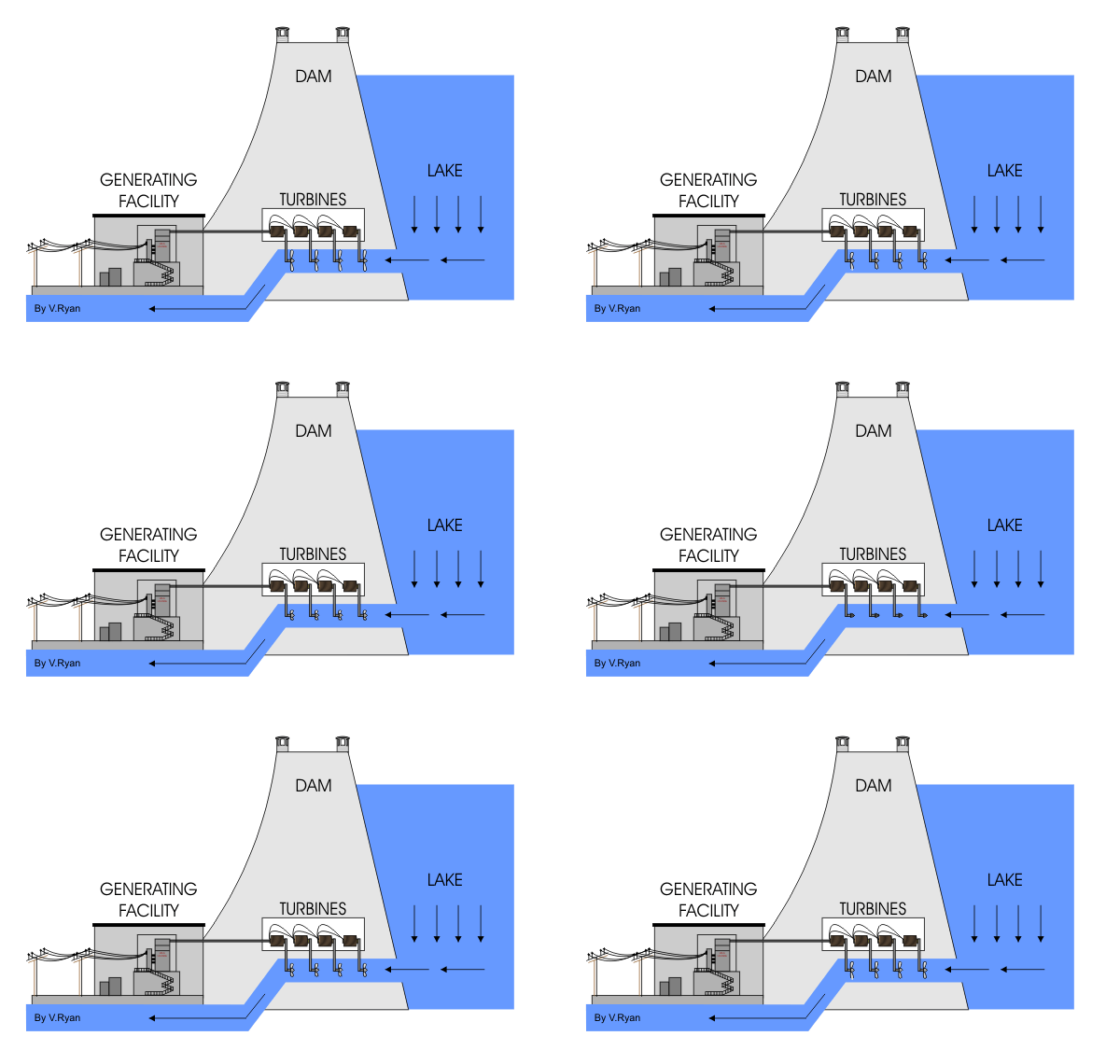
Depending a full 70% on renewable energy, of course our Kiwi friends in New Zealand have some resources about Wave, Wind and Solar Power. (They even have an education initiative to combat climate change & peak oil!)

(Above three images from NZ Gov't Website.)
(I think I can post it. Anyone a lawyer?)

New Zealand's "West Island" (Australia) seems to have some abnormally high heat flows, making Geothermal power an attractive option to private entities there.


(Above two images from Geothermal Resources Limited)

Meanwhile, a voluntary 'Friends of the Earth' group back in the motherland of the UK clearly understands the cons of renewable Tidal power. Hopefully they are helping to work through these for the betterment of the Earth's total state, rather than just blocking them to save one ecosystem!

(Above image from Marinet.org.uk and originally Swan Turbines.)

And finally...
We get to two groups who seem to offer what I was looking for, although even this is a bit complex for a 1 day introduction. Perhaps either group is interested in developing a condensed primer?

The first is from the BBC, and is almost complete, but could use a few more illustrations.

The second is an excellent resource, even though I hardly know who is responsible for it! I wish I'd found this generic teacher's resource a few weeks ago. (Maybe appearing on tiny blogs like this one will help it gain popularity? Ha! Doubtful.) Anyway, I wish them luck and continued quality content! Seems like the World Association of Technology Teachers is a pretty cool group!

(Above photo from technologystudent.com)

And another "good" site about alternative energy by an Italian University could use simple graphics to complement their thorough work.

I had heard there were some good California government sites, but found only two worth reposting:
http://www.energy.ca.gov/
http://www.eere.energy.gov/states/alternatives/resources_ca.cfm

And the winner is:
None so far! I envision an "Introduction to Renewable Energy" information kit for teachers looking to break into this market. A primer, of sorts, for teachers and students to share. Format might be as follows:
  1. A single sheet about each (main) type of renewable energy (I know I've left some out above). This would explain at a basic level how the power is generated, give a few key facts that differentiate it from other energy sources, and have some links to further information on the web. This would be for teachers to use, and might never even get printed out (fewer trees wasted).
  2. The second item would be a single sheet with a simple illustration that graphically shows the differences between each renewable power generation method. This might be something that students can copy down in their workbooks quickly during class, to talk about with their families as homework.

A rough draft example of what #2 (above) might look like.
(Click for larger.)
Note the lack of words that clutter, and common themes: each box has an arrow showing the source of energy, and the generators/turbines are all uniform so one explanation suits most. Commonalities between various forms help with understanding at an introductory level, I would think.
(One might also note the lack of understanding on some -- especially the thermal solar power. I got lazy, I admit it. Also, anyone have an "exciting" and simple way to show how PV's work?)

In Closing...
Our friends over at Iridescent Inc. have agreed to take a look at developing some materials, if some excellent ones don't surface soon. Please leave a comment here or simply visit the Iridescent Blog and leave a note! Also, if you're an illustrator, writer, translator, educator, or even random person interested in helping these and similar efforts, please get in touch with either of us! We'll find a way to utilize your skills!