Showing posts with label startup. Show all posts

Tuesday, December 30, 2014

Why Kenya, and why now?

Some have asked “Why Kenya?” and “Why now?”


My excitement for Kenya surrounds the opportunities for early stage businesses who have a reasonably stable economic base from which to launch, myriad new tools at their disposal, and a massive, and growing population with increasing purchasing power - not all of these points are true of all developing economies!

So: Why Kenya, and Why Now?

1) Kenya has a robust non-extractive based economy. With Kenyan GDP comprising 40% of the region’s GDP, Nairobi is the economic capital of east Africa, with a stock exchange, and many corporates’ regional (or continental) headquarters. Most importantly, however is the stability - Kenya’s economy is not based on extractive industries such as mining or fossil fuel extraction - it's based on agriculture and services. I believe this makes Nairobi a bit more robust to external inputs as compared with neighbors. (Note the 25% overnight growth of GDP due to rebasing.)


Nairobi skyline (source)
2) New technology adoption has been very rapid in Kenya. This will likely continue to enable quick, massive improvements in lifestyle, healthcare, agriculture output, financial inclusion / services, communication. As landmark examples, please see success of M-Pesa (mobile money), and the numerous, successful on and off-grid solar/distributed power generation products.

M-Pesa and Bitcoin (to a much lesser extent) are in use in Kenya (source)
Off-grid solar is massive business in east Africa, including Kenya;
some key players are M-Kopa, d.light, Greenlight Planet, SunnyMoney, Off-Grid Electric, and Azuri (source)

3) Kenya has (debatably) the fastest, cheapest, and deepest penetration of internet on the continent. Wow, what an advantage in a continent where infrastructure seems to be always lacking. In Nairobi, new business incubators are all around, with the iHub proving an invaluable epicenter of activity for software-based startups, and the upcoming Gearbox promising similar excitement and opportunities for hardware startups. Prevalent and affordable internet is enabling collaboration like never before.


    Internet penetration in Kenya is high relative to continent neighbors (source)
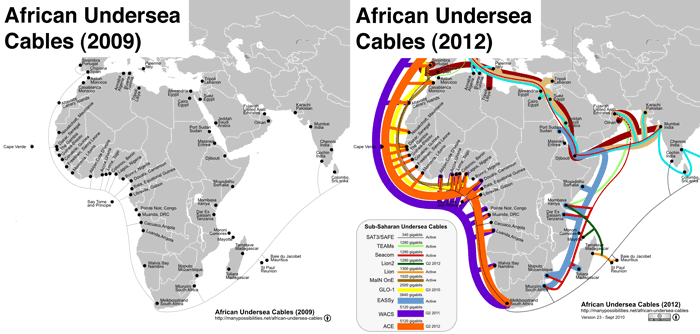
    Multiple undersea cables now connect Kenya to other countries (source)
    Due to the robust economy, the rapid technology adoption of Kenyans, and the prevalent and affordable internet, I’m excited about Kenya!


    Further reading:
    I should note that the above are *my* reasons for being excited about Kenya; plenty of other groups have published their own reasons:


    • CIA World Factbook, Kenya
    Of course there are other reasons to love Kenya; so come visit!

    Sunday, May 19, 2013

    Pasadena Gets A Spark!

    Just wrote a quick blog post about 
    the startup ecosystem 
    in Pasadena, check it out!

    Monday, April 15, 2013

    Pebble Smartwatch Review

    Wanted to share a few notes on the Pebble Smartwatch, which came out of the largest Kickstarter crowdfunding to date (as far as I know), and which I wrote about in December.  The team raised $10M in 38 days, and delivered my watch roughly 9 months after the close of the campaign, 5 months later than promised.  Despite the late delivery (FCC approval!), I'm still very happy.  As I've noted to others, part of supporting a kickstarter campaign is to support entrepreneurs, as I think they make our communities stronger.  On top of that, I got an awesome watch!
    (Here's an interesting article/debate about how investing relates to Kickstarter.)

    I'm very happy with the watch.  I felt that they did an excellent job, and even over-delivered in a few ways:
    1. Battery life is excellent.  They noted roughly a week, and that's what I get.  You might say that they delivered what they promised, but even the most honest teams in tech (Apple, Motorola, etc.) regularly give ridiculously high battery estimates, and so I was prepared for a couple of days of battery life.  My pebble lasts usually about 7 days, in my experience of a month of daily use.
    2. Screen and backlight are done perfectly.  Flick or tap your watch to see the backlight, fades out nicely, impossible to tell if the backlight is on or off during the day, contrast is super high.  LOVE it.
    3. Water-resistance to 5 ATM.  That's 130 ft below the surface.  Granted, the rating is more helpful in surviving streams of shower water than in deep free diving, for me, but the point remains that they delivered.  I was surprised by this, as the water resistance was a 'stretch goal' - when I contributed to the campaign, they hadn't decided to make that a feature.
    4. The software development team is continuing to put out software.  There was a major update just after I got my phone, and that as well as the primary setup were quite simple.  There's still some room for improvements, but the point is that they are attentive to forums/user needs, and are active in addressing those requests.  (Glad they included an easy-to-set alarm, but will have to install a countdown timer for help with daily stretching!)
    5. Build quality is good, though I expected that.  Buttons work well, magnetic-attach charging cord is super simple to use, wrist strap is comfortable.
    6. Software development through the SDK is going wild.  Super creative watch faces, like this animated Mario one, and games and other apps starting to be released, as well.  (Also, don't forget, there's horrible clock faces as well!)
      Casio 'retro' watchface: "Dub 91


      Tetris!  Well... Pebblis block game.

      (Working on some pretty watch faces!  http://www.bithangar.com/ )
    Now the downsides:

    1. The screen is plastic.  I knew this when contributing, but went forward anyway, I felt it was unrealistic to expect this group to pull off a glass screen.  Scared for the potential of scratching, I got a few Skinomi screen protectors and after a botched-application the first time around, have been using my Pebble for a week with the Skinomi on there, and very happy with how it looks.  No double-reflection or unsightly seams.


    2. The amount of notifications seems a bit finicky.  Lately I'm receiving a deluge of wrist-vibrations for next-appointments, and haven't found a good way to handle that.  Good news: it's fixable with software updates.
    Now the suggestions / requests:
    1. Menus: It should never be possible to create disturbing action by repeated pressing of single button from home screen.  As it is now, in a meeting, if I lean on a table and depress the 'enter' button, music will start playing from my phone.  I apparently did this in my sleep last night.  I'm weird, I know.
    2. Screen polarity: It would be excellent to have an option to set all non-graphical applications (ie. menus and notifications) to reverse polarity; the visual display would be much more appealing, as you wouldn't notice the large bezel of the watch, but rather notice the watch being black, and then white text floating in the middle.
    Final thought: When people ask what it's good for, and I tell them about incoming call / text / email screening, silent alarm clock, music control on the phone, various displays, I almost forget to tell them the most important thing:
    It's an awesome watch for telling time!  It's the first real watch I've bought, and I love it!


    Friday, April 12, 2013

    Brad Feld in Pasadena on Startup Communities

    Here are my notes from attending a discussion with Brad Feld at Caltech, hosted by the Caltech Entrepreneurs Forum: http://www.entforum.caltech.edu/
    The event was organized by Pasadena Innovation Council (or Innovate Pasadena?)http://www.linkedin.com/groups/Innovate-Pasadena-Public-4764238

    These are just jotted down notes, if you have questions on how they fit together, ask in the comments.  There was a Q+A after Brad's mini-lecture.

    Thanks to BackCode for the picture! https://twitter.com/backCode


    Four principles are required to build a successful startup community:


    1. The movement must be led by entrepreneurs as leaders.  The movement also requires supportive roles from the government, universities, lawyers, etc.


    2 The movement should be planned with the long term view in mind -- 20 years.  Since startups generally  take 5-20 year, possibly an average of 7, there needs to be some continuity and multiple rounds of successes and failures before the community is solid.  Plan with this long term view.  (i.e. Do not look at quarterly or annual rhythms.)

    3 The movement must be radically inclusive of all people at any level.  Anyone who wants to help is welcome.  There should be cooperation between startups  even if they are in the same space; they are all competing for a massive pie, so there is more than likely room for all to succeed, which will be easier if people are sharing success stories and lessons.  This is not a zero sum game, there is tons of extra talent outside startup world.  Bad actors filter themselves out - they'll simply not be a good fit and be less interested as time goes on.  Number 3 is the easiest to miss.  

    3.5 There should be an attitude of "give before you get".  Rewards come in strange ways, but if the attitude is to give first, there will always be massive rewards as the group grows.  There is a need for people to interact without a transactional relationship (e.g. "I did X for you, so I expect you do do Y for me."  Instead, just do X, and then move on, do X again if it benefits someone in the group.  Then Y will come.)

    4 There should be a super saturation of events.  There should always be something going on.  Don't worry about overlap, as the community starts, information will start to flow.  Host regular meetups.  Don't hold back on organizing - there's no license required.  Simply start events, see the turnout, and move on from there.  Smart people will make time for events, if only as a way to meet talent, new partners, etc.


    The topic of "Networks vs. Hierarchies" came up a number of times.  The global financial meltdown was a tipping point for networks vs hierarchies.  Status matters less.   Get access by helping others.  Flattening of hierarchies yields networks, which are efficient. Innovation and renewable.  

    Factoid: Brad believes that you can't motivate people, you can only create a context or environment that will motivate them.

    Brad has written a few books.  From what I hear, they're excellent.


    Brad keeps a blog: http://www.feld.com/wp/