Friday, April 12, 2013

Brad Feld in Pasadena on Startup Communities

Here are my notes from attending a discussion with Brad Feld at Caltech, hosted by the Caltech Entrepreneurs Forum: http://www.entforum.caltech.edu/
The event was organized by Pasadena Innovation Council (or Innovate Pasadena?)http://www.linkedin.com/groups/Innovate-Pasadena-Public-4764238

These are just jotted down notes, if you have questions on how they fit together, ask in the comments.  There was a Q+A after Brad's mini-lecture.

Thanks to BackCode for the picture! https://twitter.com/backCode


Four principles are required to build a successful startup community:


1. The movement must be led by entrepreneurs as leaders.  The movement also requires supportive roles from the government, universities, lawyers, etc.


2 The movement should be planned with the long term view in mind -- 20 years.  Since startups generally  take 5-20 year, possibly an average of 7, there needs to be some continuity and multiple rounds of successes and failures before the community is solid.  Plan with this long term view.  (i.e. Do not look at quarterly or annual rhythms.)

3 The movement must be radically inclusive of all people at any level.  Anyone who wants to help is welcome.  There should be cooperation between startups  even if they are in the same space; they are all competing for a massive pie, so there is more than likely room for all to succeed, which will be easier if people are sharing success stories and lessons.  This is not a zero sum game, there is tons of extra talent outside startup world.  Bad actors filter themselves out - they'll simply not be a good fit and be less interested as time goes on.  Number 3 is the easiest to miss.  

3.5 There should be an attitude of "give before you get".  Rewards come in strange ways, but if the attitude is to give first, there will always be massive rewards as the group grows.  There is a need for people to interact without a transactional relationship (e.g. "I did X for you, so I expect you do do Y for me."  Instead, just do X, and then move on, do X again if it benefits someone in the group.  Then Y will come.)

4 There should be a super saturation of events.  There should always be something going on.  Don't worry about overlap, as the community starts, information will start to flow.  Host regular meetups.  Don't hold back on organizing - there's no license required.  Simply start events, see the turnout, and move on from there.  Smart people will make time for events, if only as a way to meet talent, new partners, etc.


The topic of "Networks vs. Hierarchies" came up a number of times.  The global financial meltdown was a tipping point for networks vs hierarchies.  Status matters less.   Get access by helping others.  Flattening of hierarchies yields networks, which are efficient. Innovation and renewable.  

Factoid: Brad believes that you can't motivate people, you can only create a context or environment that will motivate them.

Brad has written a few books.  From what I hear, they're excellent.


Brad keeps a blog: http://www.feld.com/wp/


Wednesday, April 10, 2013

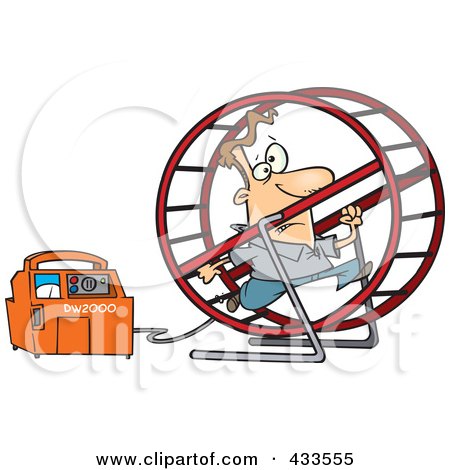
Back of the napkin: should gyms be human powered?


Just wanted to draw out a quick back-of-the-napkin calculation for folks, to investigate whether workout facilities / gyms should be 'human powered' by means of treadmills, bicycles / spin machines, or other equipment.  Imagine this waaay better drawn and appearing on XKCD or TheOatmeal.  :-)


First things first, I should say that I LOVE BICYCLE RIDING!  It's fun, healthy, encourages community bonding, basically free, reduces pollution, and it looks beautiful.


Now, on to the calculation.  How much power does a human create, roughly?  Well, a pro cyclist like Lance might make something in the neighborhood of 450 Watts.  An average adult cyclist who would go to a gym to work out might make something like 100 Watts.  (And a child might make 50 Watts, to use round numbers.)


Assume for ease of calculation that a stationary bike rider in the gym can create 100 Watts.


As a base unit, assume that they pedal for 1 hour; this would create 100 Wh (100 Watt-hours).


But electricity is normally measured in kWh (kiloWatt-hours), so we'll need 10 hours of riding, either one person for 10 hours, or 10 people on the same bike for 1 hour, etc., which yields 1 kWh of power generation.


So now let's step back to the bigger picture and find out what this same amount of energy (1 kWh) of electricity costs.  Depending where you are, and what fuel sources are used, it will generally cost between $0.08 and $0.15, so we'll use the nice and round number of $0.10.  (The latest power bill at my apartment in Pasadena shows 9.1 cents / kWh.)


So at the end of the day we're given the option to buy the electricity for 10 cents, or to have someone ride a bicycle for 10 hours straight.

Your choice: pedal a stationary bike for 10 hours, or fish a dime out of your pocket.

Caveats:

Now let's remember that we still have to buy the electrical generator (alternator) motor unit, and any sensors and display that get attached to the bicycle, and to hook up the unit to the electric grid.  This could be done as cheaply as $50, but more than likely would cost a bit more.  Again, for round numbers we'll use $100.


So now we have to pay off the parts, and at a rate of $0.10 per day, it will take us 1000 days to pay off.  If we round the length of a year down to a nice and round 333 days, that's 3 years of daily operation, 7 days a week, 10 hours per day.  During that time there's no allowance for maintenance or mechanical failure.  If the bike can operate this way for 3 years, then:
 Congrats!  That very next day, you'll be saving 1 cent for every 1 hour of pedaling.

And this is why we don't power many things with human power anymore.


Extra Assumptions:
1) Here we assume that humans want to pedal for free.  Even if they want 1 cent per hour (Note: this happens to be well below the US minimum wage of 725 cents per hour.), then there is never a payback on the electricity generation.
2) Above, we assume that there is 100% conversion efficiency between their leg output and the electricity generation.  In reality, we could use something between 50 and 70% efficiency.  But for now we'll use 100% conversion.  If we do de-rate to the round number of 50 percent efficiency, then the break-even on the capital cost of equipment is going to be 6 years.


Clip art is awesome, and I found the images used here on the following sites:


Monday, February 18, 2013

I've taken the plunge into MOOCs

I've taken the plunge into 21st century education - online learning!  A MOOC is a Massive Open Online Course where thousands (tens and hundreds of thousands) of pupils can view course content at their own pace, or choose to synchronize learning and help each other in tutorial sessions or via forums or other online tools.  Here's a Wikipedia article.

An important distinction is that online learning can return us to the one-to-one model that formal education started with (I'm thinking about individual tutors, about 500 years ago).  With online courses, there's plenty of overview material accessible via Wikipedia and other credible websites.  Then, when I need a deeper dive, I can easily, instantly find an expert who will look me in the eye (via a prerecorded video) and explain the subject.  When I don't understand, I can re-watch the video, play it slower, or take alternate videos.  When I enter a course with information I already understand, I can play the video at 1.5 or more speed.

Here's my preliminary list of online education.  Please give me any feedback / pointers / additional resources in the comments!

Khan Academy - Learn almost anything for free 

The first online course that I heard about, probably through at TED talk.  I like Khan's presentation style, and the idea that you can take successive courses that build on each other, from the same professor (ie. Arithmetic all the way through Algebra, Geometry, Calculus, and Differential Equations, and chart your progress through problem sets and final tests.  Amazingly transformative.  Not all agree.


Coursera - Take the World's Best Courses, Online, For Free


I'm currently 4 weeks into my 8 week microeconomics course, and loving it!  This happened to have the subject and timeline that fit my needs.  I'm also signed up for a macroeconomics course.  I accompany the course with a generic economics textbook, borrowed from a friend.  The course has videos, separate video tutorial (different instructor), a wiki for sharing class notes, forums for discussion, weekly goals/objectives, timeline, key phrases/concepts, and guiding questions.  I'm currently spending a bit less than the suggested 8 hours per week, total.


Udacity - Learn.  Think.  Do.


edX - The Future of Online Education


Udemy - Start Learning from the Worlds Top Instructors


This one sounds like an awesome course: Energy Economics and the Environment: Environmental issues require trade-offs, primarily in how we use energy. A former White House economist offers answers.  Free.


iTunes U - Learn Anything, Anywhere, Anytime.


MIT OpenCourseware - Free MIT courses


The Great Courses 


As far as I know, the only non-free resource on here.  Bill Gates is a huge proponent and takes classes all the time apparently.  And he's super smart.  I want to believe that these are much better than the free resources, but haven't had the opportunity to test yet.  Courses range from $50 to $300, much less than in the university setting!

Open Yale


TED - Ideas Worth Spreading


http://www.ted.com/
Not particularly academic, but excellent online stimulation tool for all sorts of subjects!


Reviews

Finally, I think we need more resources like CourseTalk, where online courses, professors, and features can be rated, for their own feedback, and for the benefit of students who want to find the BEST course in a certain subject area.  I think this type of resource will be really helpful in a couple of years once the data is in place, and I can only hope there's some semblance of uniformity between ratings, etc.